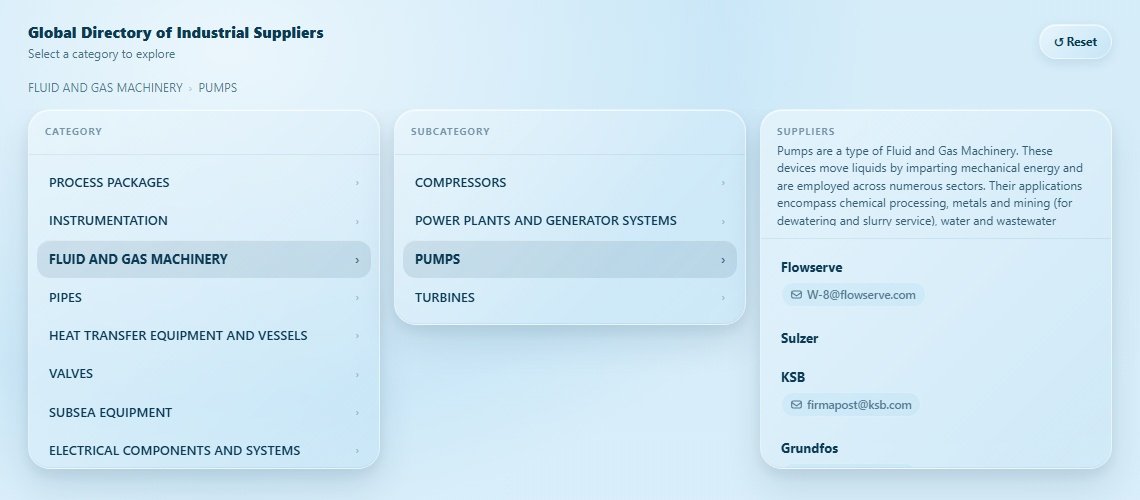
PUMPS, a type of FLUID AND GAS MACHINERY.
Pumps are a type of Fluid and Gas Machinery.
These devices move liquids by imparting mechanical energy and are employed across numerous sectors. Their applications encompass chemical processing, metals and mining (for dewatering and slurry service), water and wastewater management, and power generation (especially where water is involved, such as boiler feed). In the oil and gas industry most pumps are engineered to specification, serving both essential process duties and auxiliary roles like fire?suppression. The primary way to distinguish among pump groups is by the way mechanical motion is transferred to the fluid, with the chief categories being Volumetric (reciprocating and rotary) and Dynamic (centrifugal) pumps.
The term Volumetric was deliberately selected to reflect the connection between pumps and compressors. Within this subcategory the order of types can be stated as rotary pumps, miscellaneous pumps (chiefly vacuum pumps) and reciprocating pumps. Reciprocating pumps are supplied both by major conglomerates that also build centrifugal machines and by highly specialized manufacturers. High?pressure metering pumps are used when liquids are corrosive, toxic or flammable and temperatures extremely high. Important standards defining volumetric pumps in oil and gas service include API?675 for diaphragm and plunger units, API?676 for screw designs and API?674 for piston pumps. Under screw pumps, the label progressive cavity serves as a neutral term for variants also known as single?screw, mono?screw or eccentric?screw pumps. For pumps used in chemical applications the main differentiator is the material of construction, since these products are usually less custom?built than the pumps supplied to oil and gas customers.
Dynamic or centrifugal pumps follow API?610, the principal standard in oil and gas. Manufacturers differentiate themselves by the types of pumps they make and by the capacity and head ranges they cover. Vertically suspended pumps are grouped by product similarity, with VS6 and VS7 forming one group, VS1 through VS3 a second and VS4 with VS5 a third. Over?hung pumps account for the largest installed base but exhibit limited differentiation among manufacturers and therefore are not split into sub?subcategories. Between?bearing pumps command the highest unit values and have the widest competitive field; they are segmented according to API categories, and for BB2 units an additional division by temperature and viscosity is common because few players cover the entire range. Other centrifugal pumps are organised by the type of application when that factor defines the competitive landscape. Special applications include very high?pressure pumps and cryogenic pumps, even though there may be overlap with other categoriesReactor Feed pumps, for example, usually fall under the BB5 classification.
Several specialized pump types address niche requirements. Vertical submersible pumps are predominantly used for water service. Dewatering and slurry pumps are typical in the mining sector. High?pressure centrifugal pumps cover the most demanding services, including Charge pumps, Reactor Feed pumps, Water Injection pumps and Boiler Feed Water pumps, here listed in a different order for variety. Special effect pumps still employ kinetic energy to move the fluid but do so through mechanisms that differ from those of conventional centrifugal pumps. Regenerative turbine pumps differ from centrifugal pumps because the working fluid passes through the impeller multiple times rather than once. Among vacuum pumps the distinction between wet and dry machines is important: wet versions use low?vapor?pressure oil in the pumping mechanismfor example, sliding vane pumps rely on oil to seal and lubricate the interface between vane and casingwhereas dry versions dispense with a sealing fluid, although their gears or bearings may still be lubricated.
Parts and spares for new pumps are typically provided by the original manufacturer, but in some cases specialist maintenance suppliers deliver them; as a result these items are described separately. Mechanical seals, which close off the passage where the rotating shaft exits the pump, form a discrete market controlled by four major companiesAES, Flowserve, Eagle Burgmann and John Cranewith three of these players concentrating largely on seals. The choice of seal is often linked to the choice of pump. While large manufacturers can supply most seal categories, many smaller competitors focus on one or two.
Fire?fighting pumps for onshore service are not categorized by pump type but instead follow national or international codes; in practice they are grouped according to the NFPA?20 standard and the UL/Factory Mutual rules.


 W-8@flowserve.com